
by Lilli Newhouse | August 20th, 2026
Has performing any of your songs live changed the way you understand or connect with its meaning? If so, which one and why?
Cate Martin: I don’t think the meaning has ever changed through performing. But performing my songs live sometimes makes me adjust the pace. When performing live, I react to the circumstances, the room we’re in, the light and the time of day. I like having the freedom to adapt the performance accordingly. So using playback to add musical layers to our live performance, as many artists successfully do, has never been an option for us. I want to preserve the freedom to make changes on the spot as I read the room. It’s not about changing the lyrics; it’s more about adjusting the length of certain parts and the tempo.
If you could preserve one moment from your songwriting process in a time capsule, which moment would you choose, and what makes it so significant?
CM: Usually, the lyrics and music come to me at the same time. Micha then takes on the arrangement, with my musical ideas as the foundation and his ability to understand my musical intentions guiding him through the process. It has only happened once, but when we wrote “Promised Land” for our debut, Micha sent me the complete music and I didn’t make any changes. I simply sat down with it one morning and instantly came up with the melody and lyrics in one go. I had to leave for a day job I had at a law firm at the time, but I simply couldn’t leave the house until the song was finished. So I wrote the song very quickly and was terribly late for the office that day. But as my boss at the time was a music lover, there were luckily no consequences other than a curious, “Can I hear it?” which was very sweet.
Have creative differences between the two of you ever led to a stronger song? Can you share an example?
CM: Yes, all the time! The differences are usually very small and tend to come up right at the beginning, when we turn the first song sketch into an arrangement. We might initially imagine a detail differently, so we try out both ideas and usually find the answer quite quickly. Those small differences can lead us to something neither of us would have arrived at alone, and I feel that often makes the song stronger.
If you were to exchange creative roles for an entire album, what do you think would surprise your audience the most?
CM: I honestly couldn’t tell, as we haven’t been there yet. I would love Micha to have a go at writing the lyrics, but he keeps refusing. So, to me, that would be the most interesting thing. But I guess it’s not going to happen.
Over the years, what creative habits or perspectives have you naturally adopted from one another?
CM: Maybe we’ve both come to see opposing views as a sign of a great creative process rather than a reason not to continue with a song, as uncomfortable as it may feel at first.
Beyond music, which art form has had the greatest influence on your creative work recently, and in what way?
CM: I also paint and am currently doing my degree at art school, but I’d say my painting isn’t connected to my music. Either I work with sounds and words to articulate myself, or I paint to articulate myself. It really is one or the other. But I’m constantly surrounded by different forms of art. Micha’s photographs, which you can find in our artwork, are always around me as well. So maybe he’s my greatest influence when it comes to art influencing my work.
Is there a particular place or environment where your creativity consistently flourishes? What makes it so inspiring?
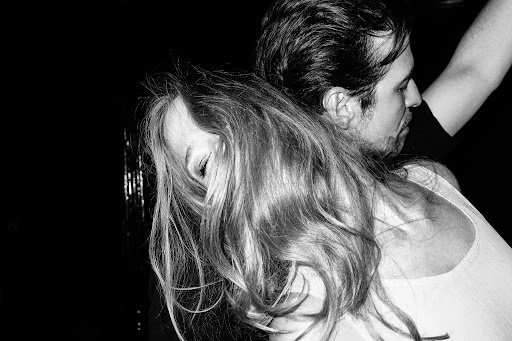
Photo by Peter Hönnemann
CM: No, there isn’t. It can happen anywhere. But there is one condition: I need to be on my own.
What is something seemingly ordinary that most people overlook but often serves as a source of inspiration for your songwriting?
CM: I find that difficult to answer, because I can’t really know what other people tend to overlook.
If you could perform one of your songs in any unconventional location, where would it be, and why would that setting complement the music?
CM: This is the first time I’ve thought about it, but I’d actually love to perform in a dark room where only the sound matters, rather than the way the music is presented visually.
If Ivy Flindt’s music were represented as a film genre, which genre would it be, and what makes it the best fit?
CM: Well, I’ve been told that it might be a good fit for film noir. But I’d say that anything with a touching, honest story might work with our music, as I at least try to be as pure as possible in what I do.
Is there a fictional character you feel could naturally exist within the world of one of your songs? If so, who and why?
CM: I can’t think of one at the moment, I’m afraid.
What creative challenge or artistic risk are you still hoping to pursue in the future?
CM: Oh, I’d love to write some upbeat songs, but I haven’t found a way to make that happen just yet.
If someone with no prior experience of music heard your work for the first time, what emotion or experience would you hope they would take away?
CM: I think I’d hope for the same thing I hope for anyone listening: that they’d be moved and found some meaning of their own in the music.
Is there a song in your catalog that continues to reveal something new to you each time you perform it? What keeps that connection evolving?
CM: When performing, I don’t reassess my songs. It’s more often people talking to me about my music that opens up new perspectives.